uniE610
Jump to Footer

Delaware River Basin Project - Land Use Dynamics

With support from the William Penn Foundation, the CLUS established the Delaware River Basin Project- Land Use Dynamics in 2015. From 2015-2017, the research focus was on developing “A Land Cover Mapping, Modeling and Monitoring System for the Delaware River Basin in Support of Maintaining and Restoring Water Resources.” A second grant was later awarded by the Delaware Watershed Research Fund (2017-2020), expanding the focus to more widely consider climate change: “How will forest ecosystems and hydrologic processes in the Delaware River Basin be affected by climate change and land cover change?”

Overview
decorative
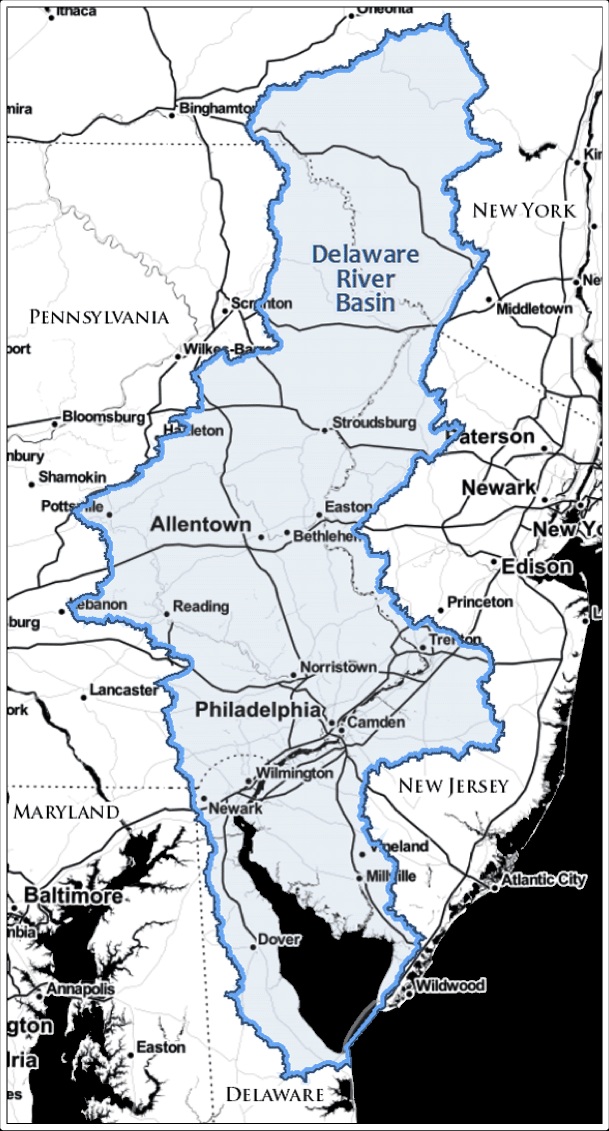
A watershed of over 13,000 square miles, the Delaware River Basin (DRB) provides water resources for roughly 5% of the US population – over 15 million people – including roughly 7 million people in New York City and northern New Jersey who live outside of the Basin (DRBC 2013). The DRB faces significant challenges: many waterways still do not meet the stated goals of the Clean Water Act to be fishable and swimmable (DRBC 2012), population growth and associated land cover changes are a concern for water supply and water quality (Jantz and Morlock 2011), gas drilling is emerging as a new industry with impacts on water supply and water quality, and climate change brings threats of sea level rise and the potential for more extreme droughts and flooding.
 
Reliable and regular land cover data are essential to address these challenges, as is the need for forecasting land cover changes in order to continually prioritize restoration and protection investments. These products need to be available Basin-wide in order to ensure conservation actions are targeted strategically. To address these needs, this project addresses three related components:
 
  • High resolution Lidar-based land cover mapping
  • Development of a Basin-wide land cover modeling tool
  • Feasibility study for long-term land cover change monitoring
 

With support from the Delaware Watershed Research Fund, a team of scientists from Shippensburg University and Northern Arizona University will connect models of land cover change, climate change, hydrology and tree species to address the impact of future development and environmental change in the Delaware River Basin.

Project Partners

Jarlath O’Neil-Dunne
Director
UVM Spatial Analysis Lab

With support from the William Penn Foundation, the University of Vermont Spatial Analysis lab is building a high resolution (1m x 1m) LiDAR-based land cover dataset for all 43 counties that cover the Delaware River Basin watershed.

Peter Claggett
Research Geographer
US Geological Survey
Chesapeake Bay Program

Together with our partners at the US Geological Survey, we are modeling future land use change based on existing data. These computer simulation tools are needed to evaluate and visualize land cover change forecasts under alternate future scenarios.

Scott Goetz, Ph.D.
Professor
School of Informatics, Computing, and Cyber Systems
Geospatial Research and Information Laboratory

Patrick Jantz, Ph.D.
Assistant Research Professor
School of Informatics, Computing, and Cyber Systems
Geospatial Research and Information Laboratory

Over the next three years, a team of scientists from Shippensburg University and Northern Arizona University will connect models of land cover change, climate change, hydrology and tree species to address the impact of future development and environmental change in the DRB.

Funding Support

Funding for this project comes from the William Penn Foundation. The William Penn Foundation, founded in 1945 by Otto and Phoebe Haas, is dedicated to improving the quality of life in the Greater Philadelphia region through efforts that increase educational opportunities for children from low-income families, ensure a sustainable environment, foster creativity that enhances civic life, and advance philanthropy in the Philadelphia region. In partnership with others, the Foundation works to advance opportunity, ensure sustainability, and enable effective solutions. Since inception, the Foundation has made nearly 10,000 grants totaling over $1.6 billion. The Foundation’s assets exceed $2.3 billion as of Nov. 30, 2014. More information about the foundation is available on its website at www.williampennfoundation.org.

Affiliate Scholars for this Project

Jacob Percey, Graduate Student Fellow

Patricia Newdeck, Graduate Student Fellow

Joshua Barth, Graduate Student Fellow

Caitlin Lucas, Undergraduate Student Fellow

Dorlisa Minnick, Ph.D., Associate Professor, Department of Social Work & Gerontology

  • B.A. in Social Work from Shippensburg University
  • M.S.W. from S.U.N.Y. - Stony Brook
  • Ph.D. in Social Work from The Catholic University of America 

Tim Hawkins, Ph.D., Professor and Graduate Program Coordinator, Department of Geography-Earth Science

  • B.A. from Colgate University
  • M.S. from Arizona State University
  • Ph.D. from Arizona State University

Scott Drzyzga, Ph.D., GISP Professor, Department of Geography-Earth Sciences

  • B.A. in Geography from State University of New York at Geneseo
  • M.A. in Geography from Michigan State University
  • Ph.D. in Geography from Michigan State University 

Claire Jantz, Ph.D. – Past Director, Deputy Secretary

  • B.A. in College Scholars from University of Tennessee
  • M.A. in Geography from University of Maryland
  • Ph.D. in Geography from University of Maryland

lfonso Yáñez Morillo, Research Analyst, Center for Land Use and Sustainability

  • A.S. in forest engineering from the Universidad Politecnica of Madrid
  • B.S. in biology from the Universidad Complutense of Madrid
  • M.S. in environmental management and administration from the Fundación Biodiversidad

Antonia Price, Project Manager, Department of Geography-Earth Science

H.B.S. in Biology from University of Utah Antonia received an Honors Bachelor of Science degree in Biology from the University of Utah, with Undergraduate Research Scholar designation.